

Wrist Tendonitis Treatment: Symptoms, Causes & Relief Guide
If your wrist hurts after typing, lifting or even holding your phone, you’re not alone. Many people deal with this kind of pain every day, especially those who work on computers. The good news is that wrist tendonitis treatment is usually simple and effective when you act early.
In this guide, you’ll learn what’s really causing your pain, how to recognize the signs, how to treat wrist tendonitis, and most importantly, what you can do today to feel better and prevent it from coming back.
What Tendon Pain Really Means
Your wrist has strong cords that connect muscles to your hand. When you overuse your hand, like typing for hours, these cords get irritated. That irritation leads to pain, stiffness and discomfort, following the same tendonitis causes and symptoms seen in other joints.
You might feel pain near your thumb, on the top of your wrist or on the side of your wrist near your smallest finger. That’s because different movements stress different parts of the wrist. For example, scrolling on your phone often affects the thumb side more.
What Happens Inside Your Wrist?
Your wrist contains several tendons that connect the muscles of your forearm to your hand and fingers. These tendons move through protective tendon sheaths that reduce friction during everyday movement.
Tendonitis in the wrist and hand occurs when these tendons become irritated or inflamed, often due to overuse or repetitive movements. When a tendon is overused, the sheath can become inflamed, causing pain, stiffness, swelling and discomfort during movement.
Common Types of Wrist Tendonitis
The most common forms of wrist tendinitis include:
- De Quervain’s Tenosynovitis: Affects the thumb side of the wrist and is often caused by frequent phone use, lifting children or gardening.
- Extensor Carpi Ulnaris (ECU) Tendonitis: Develops on the pinkie side of the wrist from repetitive typing, mouse use or gripping activities.
- Extensor Tendonitis: Occurs on the back of the wrist and is commonly linked to writing, pushing movements or repetitive wrist extension.
Warning Signs of Wrist Tendonitis You Shouldn’t Ignore
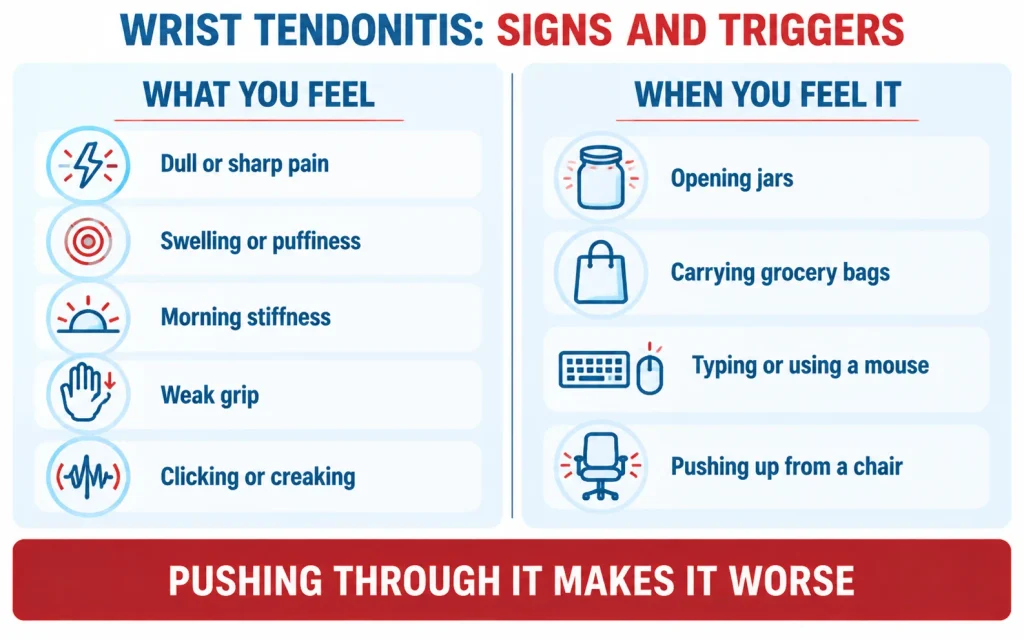
The most common symptoms of tendinitis of wrist include:
- Dull or sharp pain in the wrist
- Swelling or slight puffiness
- Stiffness, especially in the morning
- Weak grip when holding objects
- Clicking or a “creaky” feeling
Everyday Examples
You may notice pain when:
- Opening jars
- Carrying grocery bags
- Typing or using a mouse
- Pushing yourself up from a chair
What Makes the Wrist Tendon Worse
Ignoring the pain and continuing the same activity often makes it worse. Long typing sessions without breaks are a major trigger for wrist pain from typing.
Common Causes of Wrist Tendonitis
Wrist pain usually builds up over time due to repeated strain and small daily habits that put pressure on your hand without you realizing it. Wrist strain also shows up alongside other common gym injuries when lifting form breaks down. The following causes of wrist tendonitis are the most common:
- Repetitive movements like typing, scrolling or gaming strain the wrist
- Long hours of wrist pain from typing without breaks increase irritation
- Continuous mouse use adds pressure to one side of the wrist
- Poor typing posture keeps the wrist in an unnatural position
- Holding your phone at awkward angles stresses the joints
- Lifting weights with incorrect form puts extra load on the wrist
- Aging reduces flexibility and recovery speed
- Previous wrist injuries make the area more sensitive
- Health conditions like diabetes can affect joint health
- Weak hand and wrist muscles struggle to handle repeated stress
How Wrist Tendonitis Is Diagnosed
A healthcare provider can usually conduct wrist tendonitis diagnosis through your symptoms and a physical examination.
Medical History
Your provider will ask about:
- When the pain began
- Activities that make it worse
- Previous wrist injuries
- Existing medical conditions
Physical Examination
The examination may include:
- Pressing on different parts of the wrist to identify tenderness
- Checking your range of motion and grip strength
- Performing the Finkelstein test, which helps diagnose De Quervain’s tenosynovitis
Imaging Tests
If additional evaluation is needed, your provider may order:
- X-rays to rule out fractures or arthritis
- Ultrasound to identify wrist tendon inflammation
- MRI to evaluate tendon damage or other soft tissue injuries
Your provider may also rule out conditions such as carpal tunnel syndrome, arthritis, trigger finger or a wrist fracture.
Wrist Tendonitis Treatment Timeline
The best way to treat tendonitis is in stages, with care becoming more active as healing progresses.
Phase 1: Acute Management (Days 1–3)
Focus on reducing inflammation by:
- Resting the affected wrist
- Applying ice for 15–20 minutes every 2–3 hours
- Using light compression if recommended
- Keeping the wrist elevated above heart level
- Taking over-the-counter anti-inflammatory medication if appropriate
Phase 2: Relative Rest (Days 4–14)
As pain begins to improve:
- Wear a wrist brace during daily activities.
- Remove the brace periodically for gentle range-of-motion exercises.
- Continue icing after activities.
- Limit repetitive tasks such as typing, texting and heavy lifting.
- Take short breaks every hour.
Phase 3: Rehabilitation (Weeks 3–6)
Begin gradually rebuilding strength by adding stretching exercises followed by light strengthening. Resistance exercises should only be introduced once movements are comfortable and pain-free.
Phase 4: Return to Activity (Weeks 6–12)
Slowly return to normal activities while maintaining strengthening exercises and taking regular breaks during repetitive tasks.
Wrist tendonitis recovery time varies by severity. Mild cases often improve within 1–3 weeks, moderate cases typically take 4–8 weeks, while more severe tendon injuries may require 8–12 weeks or longer.
What to Do If You Still Have Wrist Tendon Pain
If your wrist pain isn’t getting better with rest and basic care, it’s a sign you may need a more structured approach. At this stage, the focus should be on supporting your wrist, reducing strain and helping it heal properly so the pain doesn’t turn into a long-term issue.
If wrist tendonitis symptoms continue despite wrist tendonitis home remedies, your healthcare provider may recommend additional therapies.
physical therapy for wrist tendonitis
Physical therapy may include:
- Manual therapy to improve mobility
- Stretching and strengthening exercises
- Activity modification
- Ergonomic education to reduce strain
Medications
Nonsteroidal anti-inflammatory drugs (NSAIDs) may help reduce pain and inflammation. Corticosteroid injections may be considered for severe inflammation but are generally reserved for persistent cases.
Surgery
Surgery is uncommon and is usually recommended only after several months of unsuccessful conservative treatment. Procedures may involve removing damaged tissue or creating more space for the tendon to move freely, followed by rehabilitation.
Most people recover fully with early treatment and proper rehabilitation. Although occasional flare-ups can happen, following your rehabilitation plan and avoiding activities that trigger pain greatly reduces the risk of recurrence.
How to Stop Wrist Tendonitis from Coming Back
The small habits that’ll help you stop tendonitis from returning are as following:
Fix Your Workspace
- Keep your wrists straight while typing
- Use a comfortable keyboard and mouse
- Adjust chair height
Build Better Habits
- Take breaks every 30–60 minutes
- Stretch your wrists regularly
- Avoid over-gripping objects
Return to Typing Safely
Start with short sessions and gradually increase time. Don’t jump straight back into long work hours.
Is It Really Wrist Tendonitis or Something Else?
Not all wrist pain comes from repeated use. Some problems can feel very similar but have completely different causes and treating them the wrong way can delay your recovery. For example, pain with numbness or tingling may point toward the carpal tunnel syndrome, while a sprain usually happens suddenly after a twist or fall.
Ongoing stiffness that gets worse with age may be linked to arthritis and sharp, intense pain after an injury could be a wrist fracture. A simple way to tell the difference is to look at how the pain started. If it builds up slowly over time and is connected to repeated activities like typing or scrolling, it’s more likely due to overuse.
But if the pain comes on suddenly, feels severe or includes symptoms like numbness or tingling or limited movement, it may be something else and should be checked properly.
When to Seek ER Care for Wrist Tendonitis
Wrist tendonitis can begin with mild stiffness or soreness but may quickly affect hand movement and daily tasks. If swelling, weakness or discomfort doesn’t improve with rest, it’s important to get it checked early. Get trusted care at Top Care ER for accurate evaluation and wrist tendonitis relief.
If symptoms become more noticeable or limit wrist movement, don’t wait to get help from our ER team for quick guidance and support. You can also visit our nearby locations, including Greater Heights ER and Garden Oaks emergency care for a detailed assessment and proper care.
