

When Should I Take My Baby to the ER in Houston Heights for Congestion?
For every parent, the sound of a baby breathing with difficulty because of a blocked nose is highly disturbing. In Houston Heights, making the choice of managing a normal cold at home or looking for professional assistance for infant nasal congestion can be very tiring.
Although baby congestion is mostly a minor, self-limiting problem, the smallness of an infant’s airways may cause a simple cold to become serious rapidly, especially in newborns under three months. This comprehensive guide will help you understand the difference between ordinary nasal blockage and life-threatening resistance to breathing. This is the most important thing to do when one wants to give proper baby congestion treatment in Houston.
Understanding Baby Congestion: The Basics
Baby congestion occurs when the nostrils are swollen and filled with mucus. Since babies are totally nose-breathers for about the first three months, any obstruction, no matter how slight, can have a very negative impact on their feeding and sleeping routine. The most evident signs of mild baby congestion are:
- Breathing is loud and raspy.
- A nose that gives out clear or thin mucus discharge.
- Coughing, mostly when the baby is lying down.
- Difficulty latching or feeding for very short durations, which is easily fixed by clearing the nose.
In such common cases, it is the supportive measures and home remedies that are the focus of the baby congestion treatment in Houston.
When Home Remedies for Baby Congestion Are Enough
In the majority of cases of simple non-serious congestion, it is advisable to use conservative measures as the first line of treatment. Sometimes offering baby congestion care at home proves beneficial, the following are a few tips that are effective:
1. Saline Drops and Suction
This is the first on the list of most effective home remedies for baby congestion.
- Put a few drops of sterile saline solution in each nostril to make the mucus thinner.
- Then, along with gentle suction, use a bulb syringe or a professional nasal aspirator before the baby eats and sleeps.
2. Humidification
The use of a cool-mist humidifier in the baby’s room not only makes it easy to breath but also loosens the thick mucus.
3. Steam Therapy
Having 10 to 15 minutes in the somewhat steamy bathroom with your baby (by turning on the hot shower) can temporarily relieve baby congestion.
4. Elevation
Slightly elevating the head of the crib (by placing blocks under the crib legs, never using pillows) can help mucus drain. In case the baby has a good appetite, the normal output of urine and stool, is smiling and active when he is awake, and is having a good sleep, then continue using home remedies for baby congestion and closely monitor.
Critical Red Flags: When to Go Straight to the Emergency Room
It is time for the ER when baby congestion becomes so bad that it hampers your baby’s breathing and the baby doesn’t get enough oxygen. If any of the symptoms listed below appear, you should go straight away to the emergency room for baby congestion in Houston Heights.
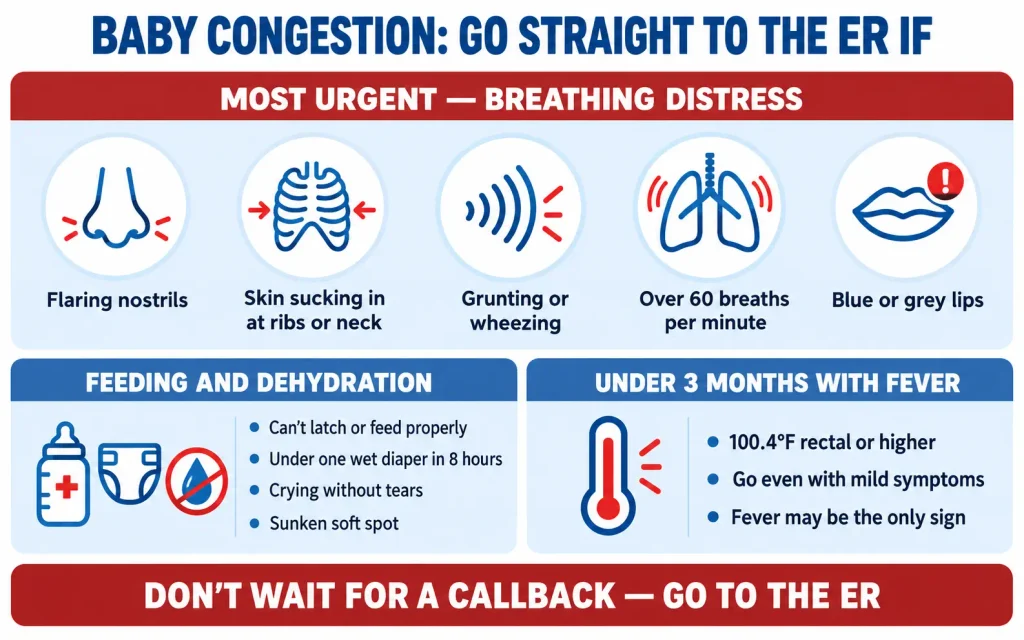
1. Severe Breathing Distress (The Most Critical Sign)
Watch out for the signs that your baby is making a huge effort just to breathe. These are the most important indicators needing an emergency room for baby congestion:
Flaring Nostrils
The nostrils are significantly opened while breathing in.
Retractions
The skin between the ribs, under the rib cage, or at the base of the neck is sucked in very deeply with each breath. This indicates that the baby is using auxiliary muscles for breathing.
Grunting or Wheezing
A grunting noise during exhalation, or a high-pitched whistling sound (stridor or wheezing) while breathing.
Rapid Breathing (Tachypnea)
A breathing pattern that is consistently much faster than the normal one (usually more than 60 breaths per minute when calm).
Color Changes (Cyanosis)
The lips, tongue, or fingertips have acquired a bluish or grayish color. This signals a lack of oxygen in the blood and thus immediately requires a visit to an emergency room for baby congestion.
2. Difficulty Feeding and Dehydration
Congestion is so intense that your little one is not able to latch on, suck only a little during bottle/breastfeeding, or severely unresponsive after waking up for feeding. Such a baby is then highly susceptible to dehydration. Below are the signs of dehydration:
- Less than one wet diaper in 8 hours.
- Crying without Tears.
- Sunken fontanelle (soft spot on the head).
It is a very critical situation when dehydration, difficulty breathing, and congestion are all present, and requires immediate baby congestion treatment in Houston.
3. Age and Fever (Especially under 3 Months)
Every feverish baby under 3 months with a temperature (rectal) of 100.4 Fahrenheit or higher must visit the ER for baby congestion treatment, irrespective of the accompaniments, a slight cough, or major baby congestion. Fever in a very young infant might be the only indication of a serious bacterial infection.
A recently revised clinical Pathway in 2025 by the Children’s Hospital of Philadelphia (CHOP), which is widely respected in pediatric emergency medicine, revealed: “Infants with severe baby congestion (bronchiolitis) need immediate escalation in care, directly supporting the advice to use the Emergency Room for baby congestion.”
Urgent Care for Baby’s Congestion
In case of a need for a rapid assessment at the medical facility, the situation can be comfortably handled at urgent care centers if the symptoms are not that severe. Consider urgent care for the treatment of baby congestion in the following cases:
- The congestion is not very severe but has lasted more than a week without any improvement (7-10 days).
- Your baby is pulling or tugging at the ear, which may indicate an ear infection, and this is making the baby’s congestion worse.
- Your baby has a moderate (for babies over 3 months) and high fever that you cannot manage using the proper infant medication.
- You are unsure if the symptoms warrant the ER, but you need professional guidance for better baby congestion care in Houston.
A doctor at the urgent care facility can identify ear infections, pneumonia, or other secondary infections, and suggest how to reinforce your home remedies for baby congestion.
| Home Remedies/ Primary Care | Urgent Care for Baby’s Congestion | Emergency Room for Baby’s Congestion | |
| Breathing | Noisy, but calm and comfortable breathing. | Persistent, rattling cough or mild wheezing. | Severe Retractions, Grunting, Flaring Nostrils, Bluish Lips. |
| Feeding | Brief pauses during feeding, but total intake is good. | Poor feeding for 4-6 hours due to stuffiness. | Refusal to feed, less than 1 wet diaper in 8 hours. |
| Fever | No fever, or a mild, controllable fever (over 3 months old). | Moderate fever for over 48 hours (over 3 months old). | Any fever in an infant under 3 months old. |
| Alertness | Happy and interactive when awake. | Slightly fussy, but responsive. | Lethargic, difficult to wake, floppy. |
| Action | Home remedies for baby congestion (saline, humidifier). | Assessment for secondary infection; prescription for baby congestion treatment in Houston. | Immediate Oxygen, IV fluids, IV medications, Intubation if necessary. |
Why Choose Top Care ER?
Top Care ER in Houston is open for patients all day and all night. You can walk in anytime for your urgent visits without a prolonged wait. We have experienced emergency physicians and nurses always on call for your guidance. Our center has its own ultrasound, lab, X-ray, and CT scan for fast and accurate results.
In The End
Baby congestion is often seen as an inevitable part of parenthood, but it requires constant watchfulness. On the other hand, home remedies can take care of mild cases. However, it is very important to know the signs of respiratory distress to provide medical care to babies with congestion. If you see the signs of flaring nostrils, retractions, or a bluish discoloration of the lips, you should skip urgent care and go straight to the Emergency Room. Seeking baby congestion treatment in Houston instantly in such extreme cases is the best thing you can do to safeguard your baby’s respiration.
