

How to Prevent Tendonitis: 6 Best Habits That Work
If you feel a constant ache in your elbow, knee or wrist after the same activity over and over, you are not alone. Learning how to prevent tendonitis is not complicated. It is mostly small habits you repeat daily, and prevention is far easier than recovery.
To prevent tendonitis, warm up before activity, increase intensity slowly (no more than 10% per week), use proper form, take a movement break every 30 to 45 minutes, strengthen the muscles around your joints, and stop at the first sign of pain.
What Is Tendonitis?
Tendonitis is irritation or swelling in a tendon, the strong tissue that connects muscle to bone. It is most common in the elbow, shoulder, knee, wrist and Achilles tendon because these areas take the most daily load, and knowing the key tendonitis symptoms and causes makes prevention much easier.
Tendonitis vs Tendinosis
• Tendonitis is short term swelling from a recent strain. It often settles with rest and care.
• Tendinosis is long term wear that builds up slowly from constant overuse, usually with little swelling.
Caught early, tendonitis is far easier to fix than damage that has built up for months.
Common Symptoms to Watch For
• A dull ache that gets worse when you move the joint
• Stiffness, often worse in the morning
• Mild swelling or warmth near the joint
• A cracking or grating feeling when you move
Why Does Tendonitis Start in the First Place?
Most tendon pain develops from small habits repeated over time. Repetitive motion is one of the most common causes of tendonitis, since doing the same movement again and again, like typing or lifting, does not give the tendon enough time to recover. Sudden intense activity and poor posture add extra strain and make it worse.
Who Is Most at Risk for Tendonitis?
• Office and desk workers: long hours typing keep the wrists, forearms and shoulders in one position too long.
• Athletes and active people: repeated loading, skipped warm ups and poor form raise the risk fast. Our sports injury emergency care team helps when a strain turns serious.
• Older adults: after about 40, tendons lose stretch and take longer to recover.
• People with health conditions: diabetes, arthritis, gout, higher body weight, smoking and some medicines all slow tendon healing.
6 Daily Habits to Reduce Your Risk of Tendonitis
These habits are the foundation of tendonitis prevention.
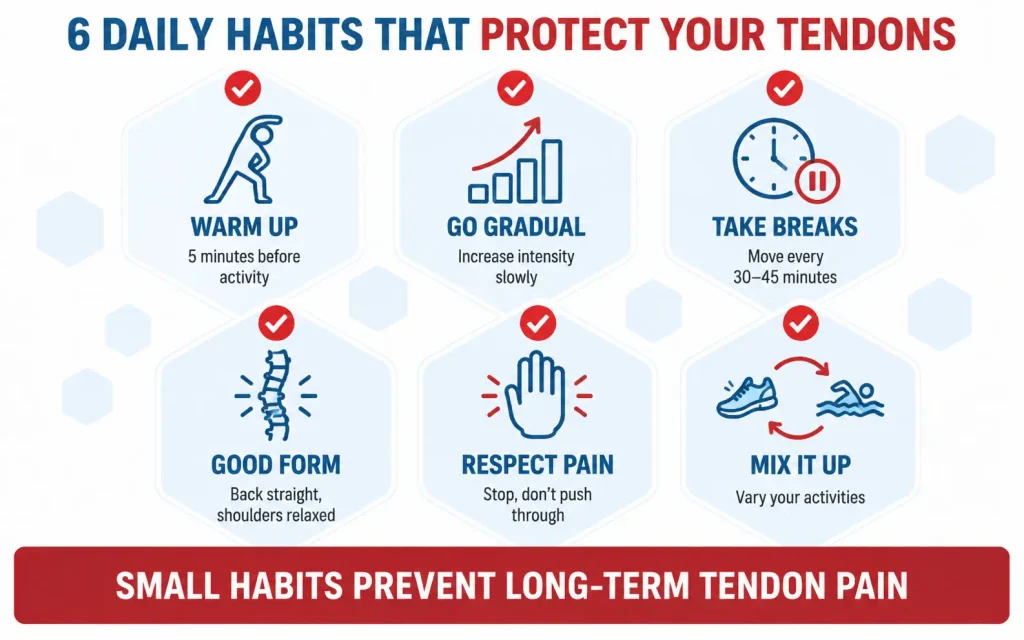
Warm Up Before You Move
A 5 minute warm up increases blood flow and prepares your muscles. Before running, try light jogging or leg swings.
Example: Before running, do light jogging or leg swings. Before lifting, use lighter weights first.
Build Up Slowly
One of the best tendonitis prevention tips is to increase intensity gradually. If you suddenly double your workout time or weight, your body struggles to keep up.
Take Breaks and Change Positions
Every 30 to 45 minutes, stand, stretch or move around for 2 to 3 minutes.
Try this: Every 30–45 minutes, stand, stretch or move around for 2–3 minutes.
Maintain Proper Technique
Keep your back straight, shoulders relaxed and movements controlled, whether lifting weights or sitting at a desk.
Tip: Keep your back straight, shoulders relaxed and movements controlled.
Stop When Pain Starts
Pain is a warning signal. Pause and rest instead of pushing through.
Instead of pushing through, pause and rest. This simple habit alone can prevent long-term issues.
Mix Up Your Activities
Doing the same activity daily overloads the same tendons. Combine running with swimming or cycling, and lift with your legs, not your back, to avoid back and neck pain.
Exercises That Help to Protect Your Tendons
Movement done right is your biggest protection.
Simple Strength Moves
Strengthen the muscles around your joints with slow, controlled work: light dumbbell curls, bodyweight squats and resistance band exercises like, Light dumbbell curls, Bodyweight squats, and Resistance band exercises.
Gentle Stretching
Stretch your hamstrings, calves and forearms. Hold each stretch 15 to 30 seconds without bouncing and focus on Hamstrings Calves, Wrists and forearms. Hold each stretch for 15–30 seconds without bouncing.
A Beginner Routine
A 5 minute warm up, 10 minutes of light strength work and 5 minutes of stretching, done 3 to 4 times a week, makes a real difference.
Foods That Support Tendon Health
No single food prevents tendonitis, but the right mix gives your body better building blocks.
• Protein and collagen: eggs, chicken, fish, beans, tofu and bone broth help build tendon tissue.
• Vitamin C, zinc and magnesium: citrus, berries, bell peppers, nuts, seeds and whole grains help repair collagen.
• Water and healthy fats: steady hydration keeps tendons flexible, and salmon, walnuts and olive oil help calm inflammation.
Office and Workplace Setup That Protects Your Tendons
• Place the top of your screen at or just below eye level
• Sit back fully so the chair supports your lower back, feet flat
• Keep wrists straight and level while typing, not bent up or down
• Keep the mouse close so you are not reaching, and rest forearms lightly
• Stand or walk a couple of minutes every 30 to 60 minutes
Tendon Care Tips for Every Age
• In your 20s and 30s: build good habits now, warm up, and learn proper form.
• In your 40s and 50s: add two strength sessions a week and give sore areas real rest.
• 60 and older: focus on low impact movement like walking and swimming, stretch daily, and add balance work.
Common Mistakes That Make Tendonitis Worse
Avoid these common mistakes if you want to stay pain-free and active.
Doing too Much too Soon
Rushing into intense workouts or suddenly increasing activity puts excessive stress on your body. Gradual progress is key, as pushing too hard too quickly often leads to strain and long-term discomfort.
Skipping Recovery
Rest is when your body repairs and rebuilds itself. Ignoring rest days or proper recovery can weaken your muscles and increase stress on your joints, making pain and injury more likely over time.
Ignoring Early Signs
Mild discomfort and stiffness are often the first warning signs of tendonitis. Ignoring them and continuing the activity can turn a minor issue into a serious problem that takes much longer to recover from.
What to Do at the First Sign of Tendon Pain
Acting early stops mild irritation from becoming a long recovery, and it closely follows how tendonitis is treated in its early stages. The key is choosing ice or heat correctly.
When to Use Ice
Use ice for new pain or swelling in the first two to three days. Wrap an ice pack in a thin towel and apply 15 to 20 minutes at a time, a few times a day.
When to Use Heat
Use heat for older stiffness, not fresh swelling. A warm pack before gentle movement loosens tight tissue. Avoid heat on a joint that is hot, red or freshly swollen.
Rest and Gentle Movement
Rest the area briefly, then ease back in with light movement. Over the counter pain medicine can help, but check with a provider first if you have other conditions.
When to Seek Emergency Care for Tendon Pain
If pain keeps increasing or limits your movement, do not wait to reach our medical team or visit a nearby location like Rice Military ER or River Oaks emergency care.
Seek emergency care quickly if you notice:
• Sudden severe pain or a popping sound at the moment of injury
• Inability to move the joint or put weight on it
• Major swelling, heat or color change around the joint
• Numbness, tingling or a limb that looks out of shape
These can signal a tendon tear or a broken bone that needs fast attention.
How Top Care ER Diagnoses Tendon and Joint Pain
At our 24/7 emergency room, our team led by board certified emergency physicians, finds the cause fast and rules out anything serious.
• Exam and history: we check the joint for swelling, tenderness, strength and range of motion.
• Emergency X ray: rules out fractures around the tendon.
• Bedside ultrasound: views soft tissue and the tendon itself.
Once we know the cause, we explain it clearly and build a plan to ease pain and support healing. Our emergency care for adults is available around the clock.
