
Should I Go To Urgent Care or the Emergency Room for a Broken Bone
We all know serious accidents and falls often result in broken bones that cause severe pain, deformity, and often heavy bleeding as well. Though minor fractures like hairline cracks in fingers, toes, wrists, or ankles can be dealt with under specialized urgent care centers, complex cases may require a visit to the emergency room for a broken bone.
In such broken bone cases, patients also arrive with life-threatening situations where surgical intervention becomes necessary. In addition, advanced imaging is also required for proper evaluation and to tailor the treatment plan accordingly.
This blog helps you decide which cases can be managed by an urgent care healthcare professional and which severe fracture symptoms require ER care in Houston.
Recognizing a Broken Bone Case
A visit to the emergency room for a broken bone becomes necessary when patients have experienced excessive force, cracks, or fractures to the bone. Such cases are usually common in falls, sports, or accidents, especially among kids and seniors. Notably, the common symptoms of these broken bone cases are usually intense pain worsening with movement, swelling, bruising, inability to bear weight, and visible deformity like shortening or angulation.
However, broken bone urgent care in Houston can also help with cases involving a hairline that causes gradual pain. Simple X-ray imaging can assist these cases with proper treatment.
When to Consider an Emergency Room Visit for Broken Bones?
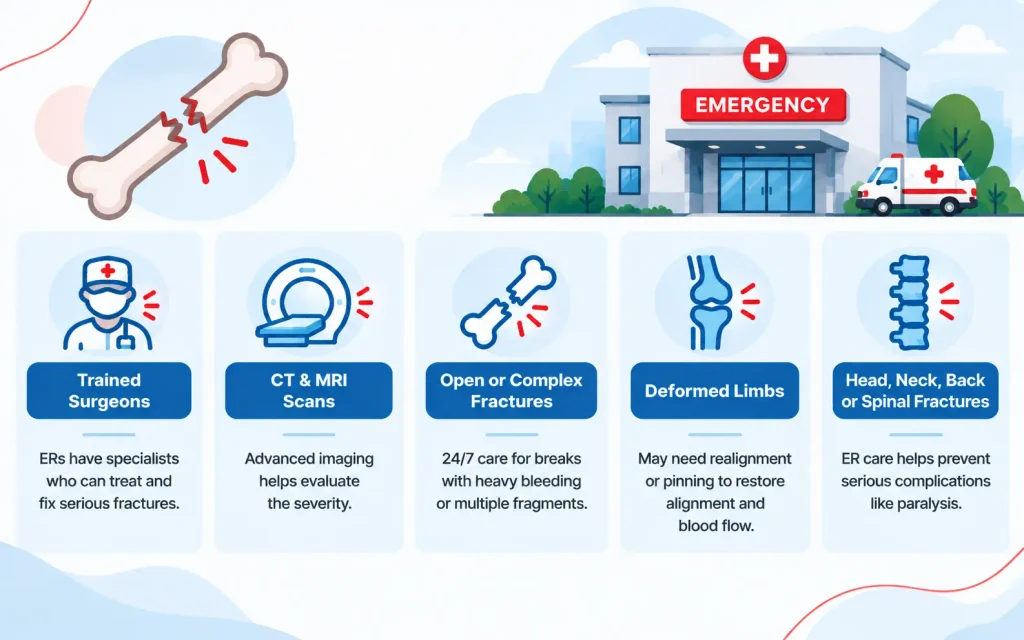
An emergency room for a broken bone case proves beneficial if the patient has limb-threatening fractures. The following are a few more reasons why ERs are a good option for critical cases:
- ERs are equipped with trained surgeons to operate and timely fix broken bones.
- ER treatment for complex fractures also involves CT/MRI scans that help in better evaluation of the severity.
- ERs are ready 24/7 for open fractures (bone pierces skin), compound breaks with heavy bleeding, or compound/multiple fragments. These are also the kinds of fractures with increased risk of infection, compartment syndrome, or vascular compromise.
- Deformed limbs, especially in weight-bearing areas like the femur or pelvis, demand ER reduction or pinning to restore alignment and blood flow.
An emergency room for a broken bone issue in Houston can also assist with head, neck, back, or spinal fractures to help prevent paralysis. These are the cases where even a gentle touch causes agony.
When is Urgent Care a Beneficial Option for Broken Bones?
An emergency room for a broken bone case might not always be the right decision. Urgent care centers in Houston also have trained healthcare professionals who expertly handle stable, closed fractures in extremities. Moreover, these centers also provide on-site X-rays, casting, and referrals without ER chaos.
Caregivers must know that urgent care is ideal for toes and fingers, minor wrist/ankle fractures, and suspected hairline/stress fractures with swelling but no deformity or neurovascular issues.
However, urgent care limitations for broken bones may make the ER a better choice, as if they spot severity, like displacement, they transfer the patient to the ER seamlessly.
Urgent Care vs. ER: Key Differences for a Quick Decision
Sometimes, it is important to decide quickly whether to go to the emergency room for a broken bone or to an urgent care center. The following table will help you make a quick and accurate decision.
| Urgent Care | Emergency Room | |
| Waiting Time | Broken bone urgent care does not require long waiting hours, as assistance arrives within 15-20 minutes. | ER services may take over an hour to assist, depending on the severity of the fracture. |
| Services | X-rays, splints, and minor casting are provided by an urgent care center. | Advanced imaging CT/MRI are provided with surgery and orthopaedic facilities on-site. |
| Overall Cost | Lower copays for Houston residents, usually starting from $100-$300. | Severe fracture symptoms double the treatment cost, usually starting from $1000+. |
| Best For | Minor fractures. | Fractures leading to deformity. |
First Aid for Broken Bones Before Seeking Emergency Care
Before rushing to an emergency room for a broken bone case, it is recommended to immobilize the injury using multiple strategies. Two of the main ones include:
The POLICE Method
ER treatment for complex fractures often gets delayed. Therefore, the POLICE (Protect, Optimal loading, Ice, Compression, Elevation) method beforehand can help elevate the pain.
The RICE Method
For a broken bone, first aid focuses on RICE (Rest, Ice, Compression, Elevation) and Immobilization, preventing further injury. This approach keeps the limb still with a makeshift splint, applying a cold pack, managing bleeding/wounds.
| Broken Bone Emergency? Do Not Delay Your Treatment and Get Immediate Assistance Contact Us Now! |
Special Considerations for Broken Bone Cases by Age and Health
The emergency room for a broken bone in Houston usually gets cases of children and seniors. They are at a higher risk due to accidental falls anytime. Even minor breaks may need ER for growth plate or osteoporosis concerns. Those with diabetes, poor circulation, or on blood thinners should be taken toward ER due to healing complications.
Why Choose Top Care ER?
At Top Care ER, we recognize that urgent situations demand immediate attention. Our skilled healthcare team is available 24/7 to manage any medical emergency. We also offer expert guidance to help you deliver effective first aid and minimize complications until medical care arrives.
Conclusions
Choosing between urgent care and the emergency room for a broken bone comes down to the severity of the case. If the injury is life-threatening, it is recommended that you head straight to the ER for proper diagnosis and treatment. However, minor fractures can be managed at specialized urgent care centers. Therefore, it is important to know about your severity levels to make an informed decision and save yourself both time and money.
