
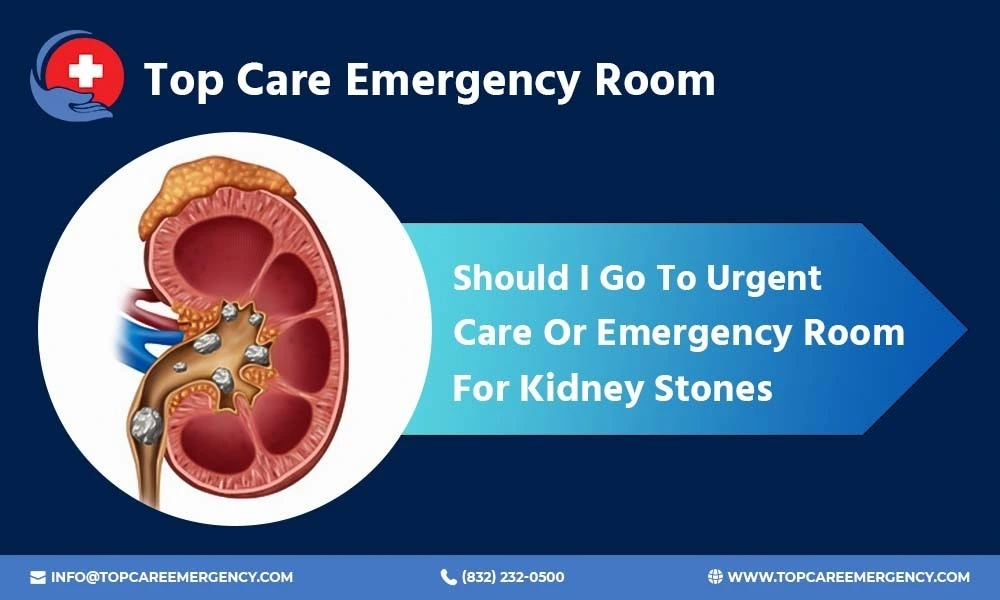
Should I Go To Urgent Care or the Emergency Room For Kidney Stones
Kidney stone pain can be some of the worst pain a person ever feels. When it hits in Houston, you need to decide fast: urgent care or the emergency room?
The right choice gets you relief sooner and helps protect your kidneys from damage. This guide explains which symptoms need the full resources of an ER, when urgent care is enough, and what each can do for severe abdominal and flank pain.
Common Kidney Stone Symptoms
Symptoms usually start suddenly when a stone moves out of the kidney and into the ureter. Common signs include:
- Sharp pain in the side or back, below the ribs, that can spread to the lower belly or groin
- Pain that comes in waves and changes in strength
- Nausea or vomiting
- Pink, red, or brown urine
- Burning when you urinate, or needing to go often
- Cloudy or foul smelling urine
Why Kidney Stones Can Need Immediate Attention
Kidney stone pain (renal colic) happens when a stone blocks the ureter, the tube that drains urine from the kidney. The blockage makes pressure build up inside the kidney (hydronephrosis). If an infection develops behind the blockage, it can lead to sepsis, which is life threatening.
Why the pain is so severe
The ureter spasms as it tries to push the stone along. These spasms, along with pressure building in the kidney, cause intense pain that comes in waves.
When delay becomes dangerous
Situations where delay may be harmful include those with the risk of sepsis and permanent kidney damage.
- Sepsis: An infected, blocked kidney can progress to sepsis quickly, with low blood pressure and a very fast heart rate. It needs IV antibiotics and drainage right away.
- Acute kidney injury(AKI): A kidney that stays fully blocked for too long can lose function for good, especially if you have only one working kidney. Timely drainage of the blocked kidney helps prevent this.
Urgent Care vs. Emergency Room for Kidney Stones
The right choice between kidney stone urgent care or ER depends on how severe your symptoms are and whether any red flags are present. Use this as a quick triage guide.
| Feature | Urgent Care for Kidney Issues | Emergency Care for Kidney Stones |
| Symptom Severity | Pain controlled with oral medications | Constant, severe pain that stops you from functioning |
| Red Flag Symptoms | None (no fever, no chills, no persistent vomiting, able to urinate) | Fever or chills, persistent vomiting, inability to urinate, one kidney, pregnancy, or signs of sepsis |
| Pain and Nausea Control | Oral pain relievers, alpha blockers, nausea medicine | IV fluids, strong IV pain medicine, IV nausea medicine |
| Diagnostics | Urine test; some centers offer X-ray or ultrasound, but most cannot do a CT scan | CT scan without contrast at any hour, full blood and urine tests, ultrasound for pregnant patients |
| Complications | Cannot treat an infected, blocked kidney | IV antibiotics right away and urgent urology care for life threatening blockages |
| Best for | Mild, stable symptoms and follow up planning | Complete blockage, suspected infection, or severe pain |
When to Go to the ER for Kidney Stones
Go to the ER if you have any red flag symptom or pain that oral medicine cannot control.
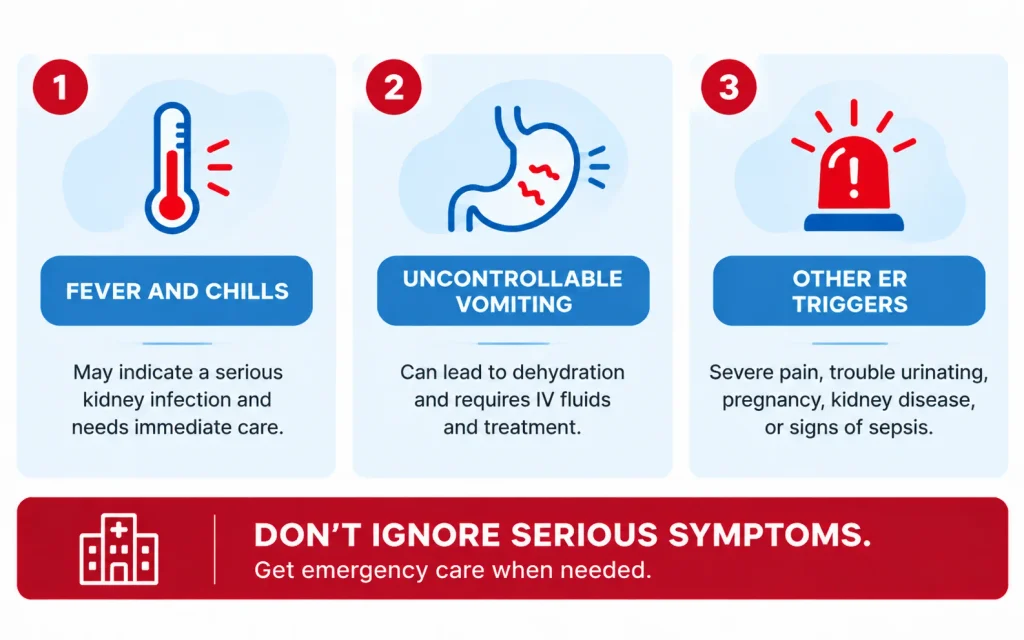
Fever and Chills
A fever of 100.4°F or higher, or chills, along with stone pain can mean an infection trapped behind the stone (pyelonephritis). This is a urologic emergency that needs IV antibiotics and urgent drainage of the blocked kidney.
Uncontrollable Vomiting
You will become dehydrated and treatment will fail if you are unable to keep fluids and pills down. The ER will give you IV fluids plus pain and nausea medicine.
Other ER Triggers
You need to go to the ER if you have any of the following:
- Little or no urine, or a sharp drop in how much you urinate
- Only one working kidney, or a kidney transplant
- Severe chronic kidney disease
- Pregnancy with severe belly or flank pain
- Pain so severe you cannot sleep or function
- Signs of sepsis: fast heart rate, low blood pressure, confusion, or extreme weakness
What the ER Does for Kidney Stones
ERs can diagnose stones quickly, control your symptoms, and connect you with urology for complex cases.
1. IV Medication
Strong IV pain relievers such as ketorolac (Toradol), unless your kidneys are not working well, plus opioids if needed and IV nausea medicine.
2. CT Scan
A CT scan without contrast shows the size and location of the stone and how much it is blocking the ureter. Pregnant patients get an ultrasound instead to avoid radiation.
3. Urology Consultation
When there is an infection, complete obstruction or threat of kidney function, urology should be consulted for stent placement or nephrostomy tube to drain the kidney. For stones that do not pass on their own, a urologist may later recommend ureteroscopy or shock wave lithotripsy to remove or break up the stone.
4. Going Home or Being Admitted
Many patients are treated and sent home the same visit once pain is under control, with a prescription, a urine strainer, and a plan to follow up with a urologist. A hospital stay is more likely if you have an infection, pain or vomiting that won’t settle, a blocked kidney that needs drainage, or reduced kidney function. Hospital stays for kidney stones are usually short.
When Urgent Care Can Help With Kidney Stones
If you are wondering can you go to urgent care for kidney stones, urgent care can be a reasonable first stop for mild, stable symptoms, especially if you have passed stones before. A first stone usually needs imaging to confirm it, and many urgent care centers cannot do a CT scan, so you may be sent elsewhere for one.
Choose urgent care if
- Your pain is mild to moderate, and some relief is achieved by pain medicine you take by mouth.
- You do not have chills, fever, or persistent vomiting and can drink fluids and take medicines.
- You require a repeat prescription, urinalysis, or a referral for more care for your stones.
What Urgent Care Can’t Do
Most urgent care centers cannot do a CT scan, have limited or no ability to give IV pain or nausea medicine, and cannot treat an infected, blocked kidney. Some offer X-ray or ultrasound, which can show some stones but not all.
What to Do During a Kidney Stone Attack
While you decide where to go, these steps can help:
- Sip water steadily if you are not vomiting.
- Use a heating pad on your side or back.
- Take a nonprescription pain reliever as the label directs, if you have no kidney disease or other reason to avoid it.
- Strain your urine so you can catch the stone.
If the pain can’t be controlled, or you develop any red flag symptom, go to the ER.
Kidney Stone Follow Up and Prevention
Knowing your stone type and your personal risk factors is key to preventing new stones.
Stone Analysis
Knowing what your stone is made of, such as calcium oxalate or uric acid, helps guide prevention. Strain your urine, save any stone you pass, and bring it to your doctor for lab analysis.
Metabolic Workup
Your doctor may order a urine collection over 24 hours to measure calcium, oxalate, and other substances that affect stone risk. The results help tailor your treatment.
Lifestyle Changes
Your plan may include drinking more water, eating less salt and animal protein, and, for calcium oxalate stones, limiting foods high in oxalate, such as spinach, nuts, and chocolate.
Why Choose Top Care ER
Top Care ER is open 24 hours a day, 7 days a week in Houston Heights, so you can walk in with no appointment and be seen quickly. We have CT scan, ultrasound, X-ray, and lab testing on site for fast kidney stone diagnosis. Our board certified emergency physicians provide IV pain control and coordinate urgent urology care when you need it.
Conclusion
Kidney stone pain with any red flag symptom needs the ER right away. Mild, controlled pain with no red flags can often start at urgent care, followed by a visit with a urologist. If you are unsure which you need, it is safer to be checked at the ER.
