

Should I Go to Urgent Care or the Emergency Room for a Sprained Ankle
During various sports or accidents, a sprained ankle is a common injury due to the forced pressure on the ankle. This injury also calls for immediate care, as sometimes a sprain can be severe and cause severe pain and movement issues. Therefore, it is important to know which urgent care or emergency room visit can prove beneficial for Houston residents in assisting timely with the right evaluation.
Patients requiring sprained ankle care must also be handled with care, as their severity levels vary. In addition, severe cases also involve ligament damage with an open wound, visible bone, and signs of circulation issues. Therefore, knowing where to rush the patient can reduce complications along with timely, effective treatment.
Understanding Ankle Sprain Injuries
Sprained ankle care is equally necessary for any minor fracture, as in such conditions, patients also experience ligament stretch or tear from twisting or rolling the ankle. Such cases usually occur during sports or on uneven steps.
According to a published study by the National Library of Medicine: “Ankle sprains affect approximately 2 million people annually in the United States, making them one of the most common musculoskeletal injuries. Emergency department data reports an incidence rate of 2 to 7 sprains per 1,000 person-years in the general population.”
Significantly, an ankle injury diagnosis usually ranges from mild (grade 1, minor stretching) to severe (grade 3, complete tears). In addition, it may also be assessed by identifying the following symptoms:
- Increased pain.
- Swelling and bruising when trying to move.
- Limited motion.
Sprained ankle care for mild cases can be carried out by the simple RICE (rest, ice, compression, elevation) method. However, worsening symptoms signal the need for professional evaluation.
Key Signs to Watch For a Sprained Ankle
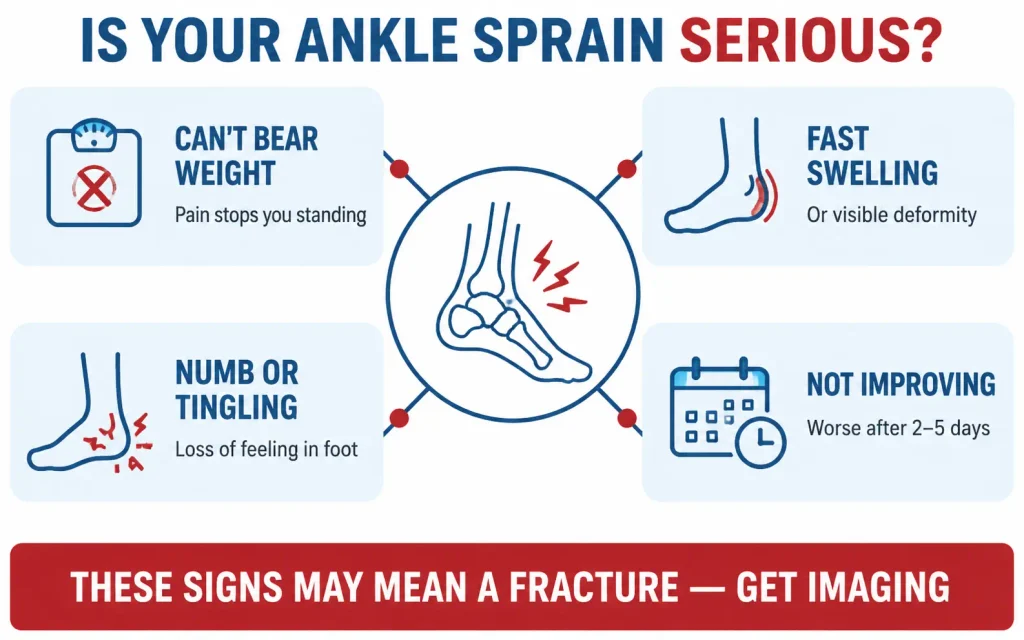
It is important to assess the severity to immediately decide on the treatment for a sprained ankle. The following are a few key signs caregivers also must be aware of when dealing with such patients in Houston:
- Sprained ankle care becomes necessary if there is severe pain preventing weight-bearing.
- Rapid swelling, even due to slight movements, with visible deformity, numbness, or tingling in the foot.
- Unable to walk more than a few steps or worsening symptoms after 2-5 days of home treatment.
These red flags help distinguish sprains from fractures or other issues requiring imaging.
When Urgent Care is a Good Option for a Sprained Ankle
Sprained ankle urgent care in Houston can be considered depending on certain minor scenarios. These specialized urgent care centers can offer the patient the following:
- Quick physical exams for sprained ankle care and to check range of motion, tenderness, and stability.
- On-site X-rays rule out the risk of fractures.
- Trained healthcare professionals at urgent care can also prescribe you pain relief medication, crutches, or splints as needed.
These specialized centers also create personalized recovery plans, including referrals to orthopedics or physical therapy, often without ER-level waits.
When to Consider an Emergency Room Visit for a Sprained Ankle?
Sprained ankle emergency care in Houston must be considered for high-impact accidents, suspected multiple injuries, open wounds, or circulation problems like pale/cold toes. Moreover, emergency room care proves to be a beneficial option when the patient is also diabetic and has a heart condition.
With sprained ankle care being provided at an ER, the patient can further benefit from advanced labs and imaging. However, caregivers must know that ERs prioritize life-threatening cases, so sprains may involve longer waits despite the capability to handle them.
Suggested Home Care Before Seeking Urgent or Emergency Care
After an ankle injury diagnosis and knowing that it is a minor sprain, one can first check out a few home remedies rather than rushing directly to an urgent care center or an emergency room. The following are a few tips that caregivers can follow:
- Start with RICE treatment for the first 48 hours.
- Sprained ankle care also involves rest with icing for 15-20 minutes hourly.
- It is suggested to wrap the sprained ankle with a compression bandage and elevate it above heart level.
- Over-the-counter pain medications like ibuprofen also help in reducing swelling if tolerable.
However, if no improvement in pain or ability to bear weight after a few days, escalate to urgent care.
Treatment and Recovery Timeline of a Sprained Ankle
At the urgent care centers of Houston, you can get treatment for a sprained ankle only including immobilization and pain management for grade 1-2 sprains. With their timely support, recovery is possible in 2-6 weeks, and you start gaining your strength back gradually.
However, severe cases may need to consider sprained ankle emergency care in Houston. These cases may involve boots or surgery treatments, but most avoid this with early intervention.
Added Prevention Strategies for a Sprained Ankle
Healing can be made fast with proper sprained ankle care. Patients are suggested to add some balance exercises like single-leg stands or calf raises to cut re-injury risk. Additionally, they are also recommended to wear supportive shoes, tape their ankles for sports, and warm up properly. Moreover, following proper landing techniques during activities reduces twist chances.
Costs and Convenience Factors for Sprained Ankle Treatments in Houston
Sprained ankle urgent care in Houston usually costs less, often $100-200. However, if you consider ERs, then it may lead to $1,000+, with walk-in availability evenings/weekends.
Another benefit of choosing an urgent care center is that no appointments are needed, unlike specialists. Furthermore, insurance typically covers sprains, but first check your copays.
The following chart further helps you decide which option is better for sprained ankle care.
| Urgent Care | Emergency Room | |
| Wait Time | 15-30 Minutes. | May require more than an hour. |
| Cost | Less, usually $100-$300. | More, starting from $1000+. |
| Sprain Services | X-ray, splints, and physician-subscribed medication. | Advanced imaging, surgery if necessary. |
| Most Suitable For | Mild-moderate sprained ankle care. | Potential deformity. |
| Houston Availability | Walk-in anytime. | Hospital-based 24/7. |
Common Myths About Ankle Sprains
The following are a few common myths that are associated with the fast healing of a sprained ankle:
- An ankle injury diagnosis does not always mean that a fracture has taken place.
- Walking it off does not always work. However, it might worsen the situation.
- Kids and athletes heal faster, but a still detailed evaluation with X-ray analysis is necessary.
Caregivers must know that urgent care handles 90% of sprains efficiently. Therefore, you must consult a provider for personalized advice.
Why Choose Top Care ER
At Top Care ER, we understand that critical issues require timely assistance. Therefore, our trained healthcare professionals are ready 24/7 to deal with any medical emergency. Moreover, our experts also guide you with insights that can help you provide timely first aid to critical patients and avoid more complications before help arrives.
Conclusions
Sprained ankle care can be managed by both emergency rooms and specialized urgent care centers. However, it is often recommended to opt for the latter one as most cases receive timely X-rays, bracing, and guidance without the extended waits and higher costs of the emergency room. In addition, it also assists ERs in focusing on more complex cases requiring timely attention. However, if the patient experiences deformity, numbness, or circulatory issues, then ER must be considered.
