
How Long Does It Take a Broken Bone to Heal? Fracture Recovery Timeline
Broken bones generally take 6-8 weeks to heal. Healing time can vary based on the type of bone, the location of the break, and other factors. For example, a broken bone in the thigh or shin can take 6-12 weeks to heal and full strength may not return for even longer. So how long does it take a broken bone to heal in your case? It depends on which bone broke, how it broke, your age and your overall health.
This guide covers fracture recovery time by bone, the stages of healing and what can speed up or slow down your recovery. It also explains when a broken bone needs emergency care.
What Are the Stages of Bone Healing?
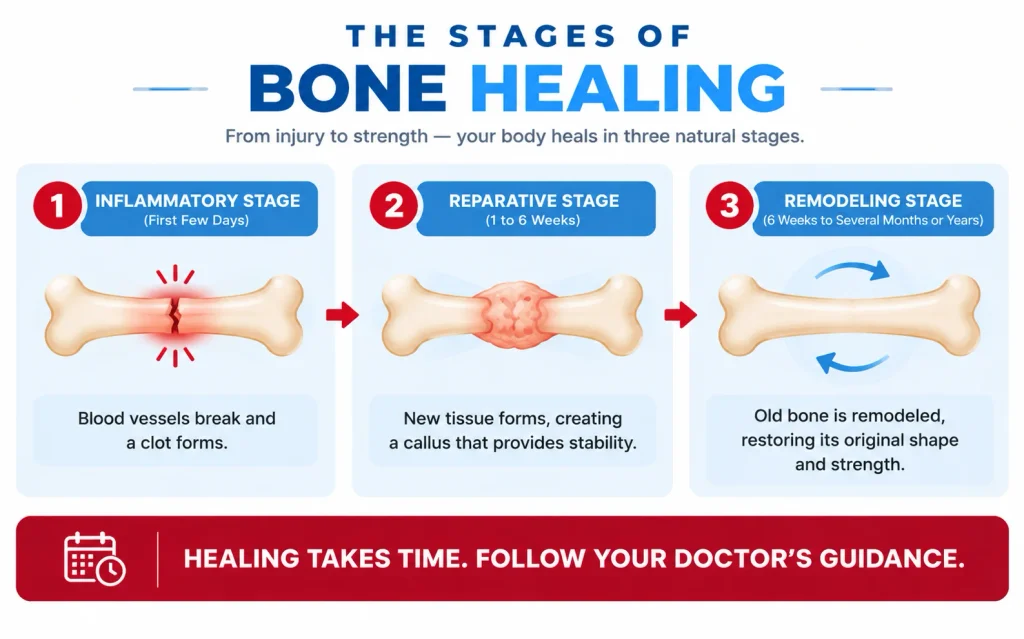
Every fracture goes through three stages. Knowing this bone healing timeline helps explain why recovery takes weeks and not days.
Inflammatory Stage (First 1 to 2 Weeks)
This is the very first stage of how long does it takes a broken bone to heal. Right after the break, blood vessels in and around the bone tear and bleed. The blood forms a clot around the fracture called a hematoma. This clot brings in cells that clean up damaged tissue and start the repair. Pain, swelling and bruising are strongest during this stage.
Repair Stage (About 2 to 12 Weeks
After a break in the bone, soft tissue known as a callus, bridges the gap. Over time, the callus hardens and becomes bone. The time it takes for this process to occur depends on the type of fracture. Generally, for the adult fractures, it takes between 6 to 12 weeks for the bone to be shown as healed in an x-ray.
Remodeling Stage (Several Months to a Year or More)
The bone is still adjusting to its new shape. A type of cell called osteoclasts eats away extra bone, and a type of cell called osteoblasts adds more bone. At this point, the patient no longer feels as much pain, if any at all. There is still, however, a great deal of work going on to fully heal the bone.
Fracture Healing Time by Bone
On how long it takes a broken bone to heal, people often ask, “How long does a fracture take to heal?” or “How fast can a fracture heal?” However, it is important to note that each bone being different from the other requires a different healing period. Some heal fast while others can take several weeks. Here is the typical fracture recovery time for common breaks in adults.
| Bone | Typical healing time |
| Fingers and toes | 3 to 6 weeks |
| Hand bones | 4 to 6 weeks |
| Scaphoid (small wrist bone near the thumb) | 6 to 12 weeks, sometimes longer |
| Collarbone | 6 to 12 weeks |
| Ribs | About 6 weeks |
| Spine (compression fracture) | 8 to 12 weeks |
| Pelvis | 8 to 12 weeks |
| Hip | 10 to 12 weeks for the bone; full recovery often takes several months |
How Long Does a Broken Leg Take to Heal?
Leg bones support a lot of weight. This makes them susceptible to fractures and means that some of them take a long time to heal. A fracture of the thigh bone or shin will take between 3 to 6 months to fully heal. The smaller bones of the lower leg and foot will take between 6 and 10 weeks to fully heal. Healing time will always depend on the specific bone that was broken:
- Thigh Bone (Femur): The femur is the largest bone in your body. A break usually needs surgery and takes about 3 to 6 months to heal. Full recovery, including walking normally, can take up to a year.
- Shin Bone (Tibia): A broken shin bone usually takes 4 to 6 months to heal. The tibia has less blood flow than many other bones, so it can heal slowly. Broken shin recovery time can be longer if the break is open or shattered.
- Fibula: The fibula is the thin bone on the outside of your lower leg. When it breaks on its own, it often heals in about 6 to 8 weeks.
- Ankle: Most ankle fractures heal in 6 to 10 weeks. Breaks that need surgery may take up to 12 weeks, and swelling can last for months.
- Foot: Most broken foot bones heal in 6 to 8 weeks. Heel bone breaks and some fractures of the outer foot bone (fifth metatarsal) can take 3 months or longer.
When Can You Walk After a Broken Leg?
This depends on the bone and your treatment. Some people walk in a boot within a few weeks. Others must keep weight off the leg for 6 to 12 weeks. Your doctor will tell you when it is safe, usually after an X-ray shows healing. Your total broken leg recovery time includes physical therapy to rebuild strength. For major breaks, leg fracture recovery time is often 6 months to a year.
Broken Leg Surgery Recovery Time
Surgery with rods, plates or screws holds the bone in place. It does not make the bone heal much faster, but it often lets you move sooner. Bone healing after surgery still takes about 3 to 6 months for the femur or tibia.
How Long Does a Broken Arm Take to Heal?
Most broken arms heal in 6 to 12 weeks.
- Wrist (end of the forearm bone): 6 to 8 weeks
- Forearm (radius and ulna): 6 to 12 weeks
- Upper arm (humerus): 8 to 12 weeks
- Elbow: 6 to 8 weeks for simple breaks, and longer if surgery is needed
Most people wear a cast or splint for 4 to 8 weeks. Stiffness is common after the cast comes off, and therapy can take several more weeks.
How Long Does a Minor Fracture Take to Heal?
A minor fracture, like a hairline crack or a small chip, usually heals faster than a full break. So how long does a small fracture take to heal? Most take about 4 to 8 weeks.
- Hairline or stress fracture: 6 to 8 weeks with rest from the activity that caused it.
- Cracked bone that stays in place (nondisplaced fracture): 4 to 8 weeks, since the pieces stay lined up.
- Chipped bone (avulsion fracture): 4 to 8 weeks.
Can a Fracture Heal in 2 Weeks?
Not fully. At 2 weeks, the bone is only starting to form a soft callus. Pain often gets much better by then, but the bone is still weak. Stopping your splint or boot too early can cause the break to shift or heal poorly.
Bone Healing Time by Age
Age is one of the biggest factors in fracture recovery time.
- Children: Their bones have more blood flow and grow fast. A wrist break that takes 6 to 8 weeks in an adult may heal in 3 to 4 weeks in a young child. If your child may have a broken bone, our pediatric emergency care team can help.
- Teens and young adults: They heal a bit slower than young children, but still faster than older adults.
- Adults: Most adult fractures heal in 6 to 12 weeks, depending on the bone.
- Older adults: Healing slows with age. Thinner bones from osteoporosis, slower blood flow and other health problems can add weeks or months. Hip fractures in older adults often need surgery and months of rehab.
What Factors Affect Bone Fracture Healing Time?
Most fractures heal well. But research published in BMJ Open notes that about 5 to 10% of fractures may not heal as expected, and some need more treatment or surgery.
When understanding how long does it take a broken bone to heal, it is important to know that several factors influence how quickly bones heal. These factors typically involve the following:
Type of Fracture
How long it takes broken bone to heal is influenced by the way it breaks:
- Closed fracture: The bone breaks but the skin stays intact. These usually heal faster.
- Open (compound) fracture: The bone breaks through the skin. These usually take longer to heal than closed fractures of the same bone.
- Displaced fracture: The bone pieces move out of line, which can add weeks to healing.
- Comminuted fracture: The bone breaks into several pieces and usually takes longer to heal.
- Greenstick fracture: The bone bends and cracks but does not break all the way. This is common in children.
- Stress fracture: A small crack from repeated force, common in runners and athletes.
Nutrition
Your bones need calcium, vitamin D and protein. Significantly, these essential nutrients support the bone repair process. Low levels of these nutrients can slow healing.
Health Conditions
Certain diseases also become a hindrance in the bone healing process. Conditions such as diabetes, osteoporosis, rheumatoid arthritis and poor circulation, can all slow bone healing.
Smoking and Alcohol
If individuals with smoking habits encounter a bone fracture, recovery will automatically get slower. Due to smoking, Nicotine narrows blood vessels and cuts the oxygen your bone needs to heal. Heavy drinking can affect how your body uses calcium and slow repair.
Medications
Sometimes people use corticosteroids or nonsteroidal anti-inflammatory drugs (NSAIDs) for a very long time. It may delay bone healing by altering cell activity and mineralization.
Stability And Immobilization
A bone heals best when it stays still and lined up. A cast, brace, splint or surgery keeps the pieces in place so they can join.
Does a Fracture Need Surgery?
Many fractures heal with a cast or splint. Surgery may be needed when:
- The bone pieces are far out of place
- The bone is broken into many pieces
- The bone has broken through the skin
- The break goes into a joint
- Nearby nerves or blood vessels are damaged
- The bone is not healing on its own
What Complications Can Delay Healing?
Most fractures heal without problems. But some complications can slow recovery:
- Delayed union: The bone heals more slowly than expected.
- Nonunion: The bone does not heal at all and may need surgery.
- Malunion: The bone heals in the wrong position.
- Infection: This is most common with open fractures or after surgery.
- Stiffness and weakness: This is common in nearby joints and muscles, especially without therapy.
How Can You Help a Broken Bone Heal Faster?
You can support your recovery by keeping your cast, splint, or boot on as directed and making sure it stays dry. Avoid putting weight on the injured area until your doctor confirms it is safe. In the first few days, elevating the injured limb and applying ice can help reduce swelling. Attend all follow-up visits so your doctor can monitor healing through X-rays, and complete your physical therapy exercises to restore strength and movement.
When Should You Go to the ER for a Broken Bone?
Go to the ER right away if you think you broke a bone and:
- The arm or leg looks bent or out of place
- Bone is pushing through the skin
- You cannot move it or put weight on it
- You feel numbness or tingling, or the skin looks pale or cold
- There is heavy bleeding
Our broken bone care team can check the injury with an on site emergency X-ray and start treatment fast. If you are not sure where to go, read our guide on urgent care or the ER for a broken bone.
During recovery, get emergency care if:
- Pain gets much worse and medicine does not help, especially with a tight cast
- Fingers or toes below the cast turn numb, pale or blue
- You have fever, redness or drainage near a surgical wound
- Your calf becomes painful and swollen, or you have sudden chest pain or trouble breathing. These can be signs of a blood clot.
Why Choose Top Care ER in Houston Heights?
At Top Care ER in Houston Heights, our board certified emergency physicians treat broken bones 24 hours a day, 7 days a week. With on site X-ray, we can find the break quickly. We place splints, manage your pain and connect you with an orthopedic specialist for follow up care. No appointment is needed.
Conclusion
Most fractures heal in 6 to 8 weeks, while a broken thigh or shin bone can take 3 to 6 months. Your fracture recovery time depends on the bone, the type of break, your age and your health. Following your treatment plan gives your bone the best chance to heal strong. If you think you have a broken bone, Top Care ER in Houston Heights is open 24/7 to help.
