
When Should I Take My Child to ER in Houston Heights for Fever?
A fever in a child is certainly among the most typical occurrences, and at the same time, it may also be one of the most alarming conditions for parents to deal with. In most cases, the child’s fever is a natural reaction of the body to the minor infection. However, there are moments when the fever indicates a more severe problem, and those issues should be recognized quickly.
What separates a simple sickness from a serious child fever emergency is usually the age of the child, the temperature measurement, and the presence of extreme symptoms that come along with it.
This article will guide you to manage your child’s fever confidently, identify the major signs for immediate medical attention, and know exactly when to take your infant to an emergency room for fever.
The Critical Role of Age: When a Fever is Always an Emergency
The child’s age is an important determiner while assessing a fever. The younger the child, the more the chances of the case being called a child fever emergency. This is because of the newborn’s not fully developed immune system, which can hide a serious infection until it becomes progressive.
1. Infants Under 3 Months (0-90 Days)
The case of fever of this age group is always referred to the pediatrician as a medical emergency unless otherwise established.
The Temperature Threshold
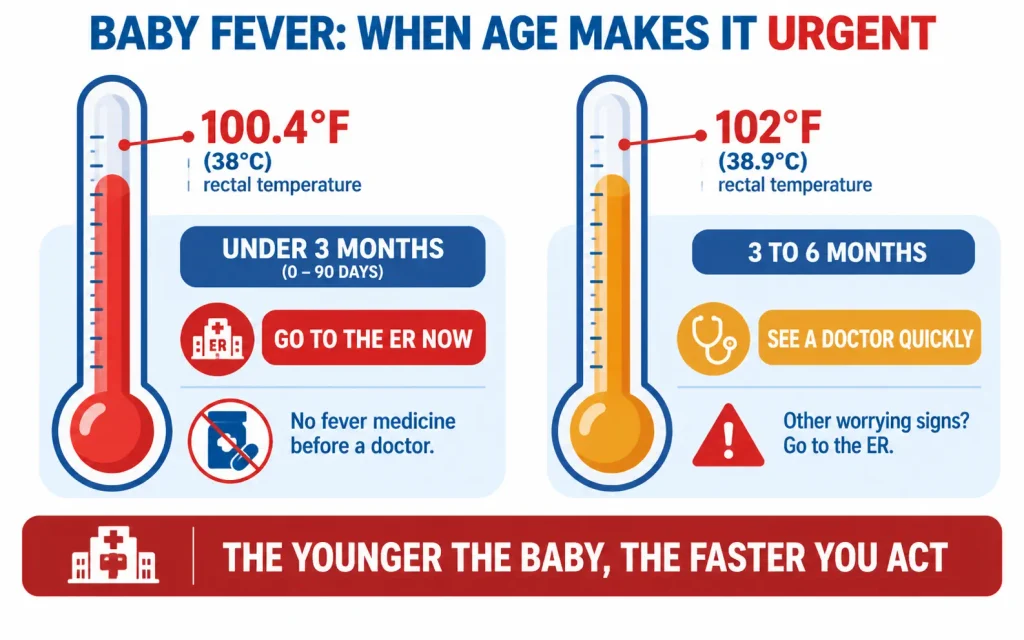
- If your baby is under 3 months old and has a rectal temperature of 100.4°F (38.0°C) or above, then you should call for emergency medical help without any delay.
- Do not administer any fever-lowering medication (for instance, Tylenol or ibuprofen) before consulting a doctor or getting to the ER, as this could hide crucial symptoms and make the diagnosis harder.
The Action
In the Houston Heights area, if your baby meets this criteria, going straight to our urgent care Houston Heights location or pediatric ER is indeed the safest option. It is considered a child fever emergency that should not be overlooked.
2. Babies 3 to 6 Months Old
For this group, receiving timely treatment should be the priority. However, the fever threshold is set a little higher.
The Temperature Threshold
Taking the rectal temperature, a fever of 102°F (38.9°C) or more requires immediate child fever care by a pediatrician.
- If there are other worrisome signs and you can’t get a pediatrician, it will turn into a fever emergency.
- The aim here is to have a physician see your child as soon as possible.
- This group of babies needs a doctor’s appointment quickly, so the right decision about the fever should be made.
In fact, pediatrician visits of the 3-6-month-old group are common in the case of fever, and judging by their appearance and behavior, they are given the right child fever care.
Beyond the Thermometer: The Danger Signs that Require an ER Visit
The temperature can definitely point out the situation, yet the symptoms that come along with it are the main signs of a severe child fever emergency. No matter how old the child is or what the temperature is, if any of the signs mentioned below are observed, the fastest and most thorough medical care, preferably the emergency room for fever, should be sought.
A. Changes in Consciousness and Behavior
Extreme Lethargy or Difficulty Waking
- If your child is much sleepier than usual, he is difficult to wake or does not even look at you.
- There is a very serious wound on the head of the baby.
- If he seems “out of it” or not realizing, this is a child fever emergency and requires immediate action.
Incessant Crying/Extreme Irritation
For babies and very young children, continuous crying that is very loud and cannot be controlled may mean severe pain or a serious infection like meningitis. This is a case for an emergency room for a fever.
B. Distress in Breathing and Circulation
Breathing Trouble
- Breathing that is quick but shallow or requires effort.
- Among the symptoms are “retractions,” which are the chest being pulled in under the ribs, flaring of the nose, or a grunt-like sound accompanying each inhalation and exhalation.
- Breathing difficulties, especially when the nasal passage is unobstructed, is a condition that can cause death.
Skin Color Changes
- Skin, lips, or tongue that are pale, ashy, bluish, or blotchy (mottled) indicate not enough blood circulation or very low oxygen levels.
- Hence, the necessity of a 911 call or an immediate consultation with an emergency room for a fever.
Complicated Febrile Seizures
Most febrile seizures are harmless. However, a seizure lasting longer than five minutes should lead to immediate evaluation to rule out a severe underlying cause.
C. Neurological and Hydration Warnings
Stiff Neck or Severe Head Pain
In an older child, the incapacity to bring the chin down to the chest, together with a strong headache, is a classic indication of meningeal irritation, which constitutes a life-threatening child fever emergency.
Rash that Doesn’t Fade (Petechiae or Purpura)
Any skin erythema that looks like small red-purple dots or larger bruise-like areas that do not whiten or fade upon pressure is an emergency case. The possibility of a blood infection (sepsis) or meningococcemia is the reason behind this.
Severe Dehydration
- Watch for signs such as crying without tears, dry mouth and tongue, sunken eyes, and most importantly, no urination for 8-12 hours.
- A child with dehydration may have a fever requiring IV fluid as the only way of treating it. which is only found in an emergency room.
- This is one of the important parts of the pediatric fever guide.
Navigating Care in Houston Heights: Making the Right Choice
Houston Heights parents are lucky to have great access to pediatrics. But when you think about a child’s fever, your main concern should be getting timely treatment.
The ER vs. Urgent Care
- On one hand, Urgent Care centers deal with minor illnesses very well, but on the other hand, they are not able to provide help in life-threatening child fever emergency situations.
- Moreover, they often do not have the on-site labs, imaging, and specialists necessary for quick diagnosis and stabilization of critically ill children.
If you spot any of the “Danger Signs,” just drive past the urgent care and go to a place that has a dedicated pediatric ER or one that is really good at baby fever treatment in Houston.
Know Your Local Resources
Get to know the nearest pediatric ERs in the Houston Heights area. This knowledge of the route and the facility’s location saves minutes during a time-sensitive child fever emergency.
Summary of the Child Fever Emergency Action Plan
The patient’s visit to the Emergency Department is hard, but through these unambiguous, age-specific, and symptom-specific protocols, your little one will be guaranteed the right pediatric fever guide:
| Temperature Threshold | Accompanying Symptoms | Action: Child Fever Emergency? | |
| Under 3 Months | 100.4°F (38.0°C) or higher (Rectal). | None needed, temperature alone is the critical indicator. | Immediate ER visit (Non-negotiable). This is an absolute child fever emergency. |
| 3 Months to 3 Years | 102.2°F (39.0°C) or higher. | Any of the Danger Signs (Stiff neck, non-blanching rash, lethargy, respiratory distress, etc.) | Immediate visit to the emergency room for fever. |
| Over 3 Years | 105°F (40.5°C) or higher. | Any of the Danger Signs (Stiff neck, non-blanching rash, lethargy, respiratory distress, etc.) | Immediate ER visit. High temperature plus other symptoms are considered a child’s fever emergency. |
Why Choose Top Care ER?
Top Care ER in Houston is open for patients all day and all night. You can walk in anytime for your urgent visits without a prolonged wait. We have experienced emergency physicians and nurses always on call for your guidance. Our center has its own ultrasound, lab, X-ray, and CT scan for fast and accurate results.
Conclusions
At the end of the day, pediatric fever guides help in managing emergency situations where trusting your instincts might not be the safest option. When your child “just doesn’t look right,” then it is always best to play it safe. No physician will criticize a parent for having an appointment in case of a child’s fever emergency. Early awareness and the right treatment applied immediately can be the decisive factor in a critical condition. By being aware of the important indicators, you can, with assurance and speed, deal with the issue and get the best baby fever treatment in Houston.
Frequently Asked Questions (FAQs)
Q1. Should I give fever medicine right away?
The main purpose of medication in child fever care is to make your child comfortable. If they are playful, drinking, and seem okay, you don’t have to medicate just to lower the number. Give an age-appropriate dose if they are fussy, in pain, or refusing fluids.
Q2. How long can a fever last before I worry?
Call your pediatrician if the fever lasts for more than 24 hours in a child under 2 years old, or more than 72 hours (3 days) in an older child. A persistent fever needs medical attention.
Q3. What temperature is actually considered a fever?
A temperature of 100.4°F (38.0°C) or higher (rectal measurement) is classified as a fever. For babies, the rectal method provides the most accurate reading.
