
When to Go to the Emergency Room for Abdominal Pain?
Most stomach aches are mild and go away with rest. Some are not. Knowing when to go to the ER for abdominal pain can help you catch a serious problem early, such as appendicitis, a blocked bowel or bleeding inside the belly.
Your abdomen holds many organs, including the stomach, liver, gallbladder, pancreas, intestines, kidneys and reproductive organs. Pain can come from any of them. It can feel sharp, dull, crampy or burning. That is why stomach pain is hard to judge at home.
This guide explains when to go to the emergency room for stomach pain, what the ER will do and how to choose between urgent care and the ER.
When Is Abdominal or Stomach Pain an Emergency?
Go to the ER for abdominal pain that is severe, keeps getting worse over a few hours, or comes with a hard or swollen belly, vomiting blood, black stool, high fever, fainting, or no stool or gas. The ER can run labs, CT and ultrasound in one visit.
However, emergency care is not always necessary for a abdominal pain as it may resolve with simple home remedies. Stomach pain emergency care can provide timely evaluation and treatment.
According to a published study by the National Library of Medicine:
“Gastrointestinal complaints, including abdominal pain, account for around 11% of total ED visits, with about 16.6% of those patients admitted to the hospital for further care.”
Key signs and symptoms for when to go to the emergency room for abdominal pain include:
1. Extreme Abdominal Hardness or Tenderness
Sometimes your abdomen gets firm and may signal serious inflammation or internal bleeding. This is an extreme emergency case requiring medical evaluation.
2. Severe, Uncompromising Pain
Pain that has you doubled over or unable to stand up straight needs emergency care. So does pain that keeps getting worse over a few hours.
3. Increasing Stomach Pain With Movement
If every movement makes the pain worse, then it is an abdominal pain emergency care situation, and it suggests possible peritonitis or another serious condition.
4. Vomiting Or Coughing Up Blood
Vomiting blood or material that looks like coffee grounds can mean bleeding in your digestive tract. This needs emergency care right away.
5. Persistent Vomiting Or Inability To Digest Food
Constant vomiting leads to dehydration and may point to a blockage or another emergency.
6. Bloody Diarrhea Or Black, Tarry Stools
Blood in your stool or black, sticky stools can mean bleeding in the stomach or intestines. Both need prompt care in the ER.
7. Difficulty Breathing Or Chest Pain
Breathing difficulties are symptoms that may indicate complications. When severe, these can be heart-related issues mimicking stomach pain.
8. Dizziness, Fainting, Or Feeling Light-Headed
Possible signs of shock or significant blood loss are also an abdominal pain emergency.
9. Inability To Pass Stools, Gas, Or Urinate
These significant factors also result in bowel obstruction or urinary retention requiring emergency care. Dark brown urine is also a warning sign.
10. High Fever Accompanying Abdominal Pain
A fever over 101°F or shaking chills with belly pain can point to a serious infection that needs urgent treatment.
11. Abdominal Swelling Or A Bulge
A bulge may be a hernia or an enlarged organ that needs surgery. Go to the ER if your belly is very bloated and the skin feels tight, or if a bulge becomes painful and will not go back in.
Should You Go to Urgent Care or the ER for Abdominal Pain?
Many people are unsure whether to choose the ER or urgent care for abdominal pain. It really depends on the severity of the pain and the accompanying symptoms.
Stomach pain from the flu or from heartburn can usually be treated at an urgent care. However, many urgent cares can not perform an ultrasound or a CT scan on site. They also can not perform many other advanced tests. If something serious is suspected, the urgent care can not do much and the patient would be referred to the ER.
Go to the ER for abdominal pain if:
- The pain is severe or getting worse
- You have any of the warning signs listed above
- You think it could be a gallbladder attack or a kidney stone
- You are pregnant or could be pregnant
- The pain started after a fall, car accident or other injury
- You are over 50 and have new, severe belly pain
Urgent care for stomach pain may be enough if:
- The pain is mild and getting better
- You can keep fluids down
- You have no fever, bleeding or dizziness
Many people ask, “Should I go to urgent care for abdominal pain?” If you are not sure, choose the ER. At a 24 hour emergency room, you can get lab tests, imaging and treatment in one visit.
What Causes Abdominal or Stomach Pain That Needs the ER?
The following are a few underlying conditions people must be aware of and know when to go to the emergency room for stomach pain.
Common Causes
Many causes of belly pain are not life threatening, but they can still hurt a lot and need medical care:
- Gastritis: An inflamed stomach lining that causes burning pain and nausea.
- Gallstones: Sudden pain in the upper right belly, often after a fatty meal.
- Kidney stones: Sharp pain in the side or back that can move toward the groin.
- Urinary and pelvic infections: Pressure in the lower belly and burning when you urinate.
- Ovarian cysts: Dull or sharp pain on one side of the lower belly, especially if a cyst grows large or breaks open.
- Food poisoning and stomach infections: Cramping, vomiting and diarrhea. Go to the ER if you cannot keep fluids down.
- Severe constipation: Strong cramping and bloating. Learn more about when to go to the ER for constipation.
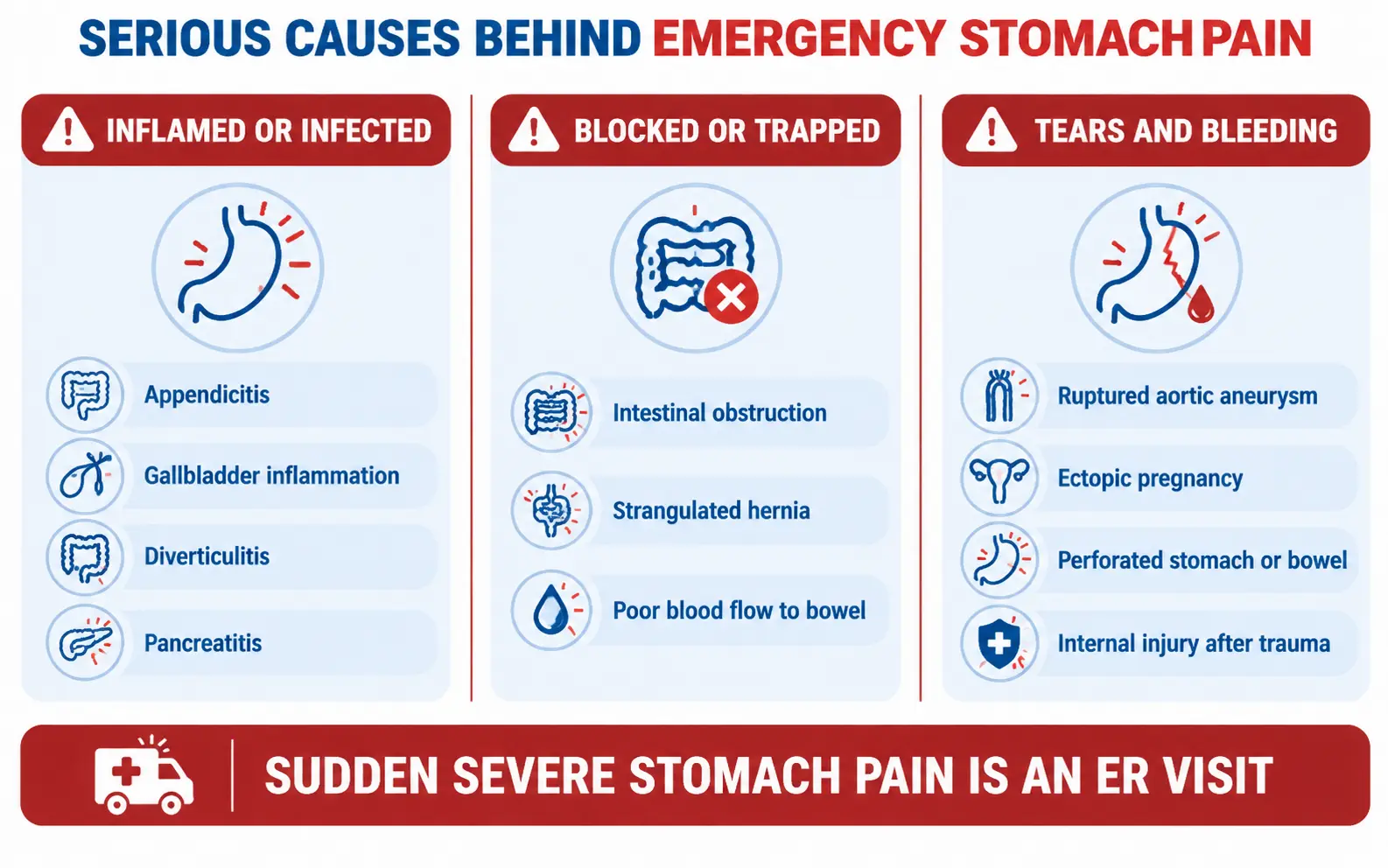
Serious Causes
Other causes are life threatening and need care right away.
1. Appendicitis and Gallbladder Infection
Appendicitis is an infection of the appendix and is one of the most common reasons for emergency surgery. Cholecystitis is an infection of the gallbladder, often caused by gallstones. Both can get worse fast without treatment.
2. Diverticulitis
Inflamed pouches in the colon wall can result in severe abdominal pain.
3. Acute Pancreatitis
Severe upper abdominal pain that worsens after eating is a hallmark sign of pancreatic inflammation.
4. Ruptured Abdominal Aortic Aneurysm
This life-threatening emergency involves a sudden tear in the major abdominal artery. Significantly, there is internal bleeding, which may increase if ignored. Therefore, rapid surgical intervention is essential.
5. Ruptured Ectopic Pregnancy
An ectopic pregnancy grows outside the uterus, most often in a fallopian tube. If it ruptures, it causes sudden pain in the lower belly or pelvis, vaginal bleeding and sometimes fainting. This is an emergency that often needs surgery.
6. Traumatic Injuries
A fall, car crash or blow to the belly can injure organs like the liver or spleen. Internal bleeding may not show right away, so get checked even if you feel okay at first.
7. Intestinal Obstruction
A blockage in the intestines causes the buildup of food, fluid, and gas. Significantly, this also results in severe, cramping abdominal pain and vomiting.
8. Strangulated Hernia
Critical stomach aches affect the herniated tissue, which loses its blood supply. This further causes intense pain and tissue death if untreated.
9. Mesenteric Ischemia
This is also a significant medical condition where the patient has poor blood flow to the intestines. This further leads to severe pain and potential bowel death.
10. Perforated Stomach Or Intestine
A hole in the wall of the stomach or intestine lets contents leak into the belly. This causes peritonitis, a severe infection that needs emergency surgery.
11. Boerhaave’s Syndrome
This is a tear in the esophagus that causes sudden chest and abdominal pain. It is sometimes mistaken for a heart attack.
How Does the Location of Pain Point to the Cause?
The location and timing of your pain can give clues about what is wrong:
- Sudden severe pain that peaks quickly: This may occur with a serious problem such as a tear or perforation in the digestive tract.
- Pain that starts near the belly button and moves to the lower right: This pattern can occur with appendicitis.
- Upper right abdominal pain with fever or nausea: This may be related to the gallbladder. The pain may also spread to the right shoulder or back.
- Upper middle abdominal pain that spreads to the back: This can occur with pancreatitis and may become worse after eating.
- Lower left abdominal pain with fever: This can occur with diverticulitis.
- Side or back pain that moves toward the groin: This pattern is commonly associated with kidney stones.
- Sudden pain on one side of the lower abdomen during pregnancy or when pregnancy is possible: This may be a sign of an ectopic pregnancy and requires immediate medical evaluation.
- Constant abdominal pain that worsens with movement: This may occur with peritonitis, a serious inflammation of the abdominal lining that can be caused by infection or other medical problems.
Upper Abdominal Pain: When to Go to the ER
Go to the ER or seek immediate medical attention for upper abdominal pain that is sudden, severe, rapidly worsening, or accompanied by warning signs such as chest pain, difficulty breathing, fainting or severe dizziness, persistent vomiting, fever, a swollen or rigid abdomen, severe tenderness, blood in vomit or stool, or pain that spreads to the chest, shoulder, or back.
Upper abdominal pain can have many causes, including problems involving the gallbladder, pancreas, stomach, liver, or even the heart. Prompt evaluation is especially important when the pain is severe or occurs with other concerning symptoms.
What Will the ER Do for Abdominal Pain?
What can the emergency room do for stomach pain? The ER team has two goals: find the cause and help you feel better.
Exam and Health History
The doctor asks when the pain started, where it hurts, what makes it worse, when you last ate and whether you could be pregnant. They then gently press on your belly to check for tenderness or swelling.
Blood and Urine Tests
Blood tests check for infection, bleeding and how well your liver, kidneys and pancreas are working. A urine test can show infection, kidney stones or pregnancy.
CT Scan, Ultrasound or X-Ray
An emergency CT scan gives a detailed look at your organs. It helps find appendicitis, blockages, tears and kidney stones. Ultrasound is often better for the gallbladder, ovaries and pregnancy. X-rays can show a blocked bowel or free air from a tear.
Pain and Nausea Medicine Through an IV
Most patients get an IV. This lets the team give pain and nausea medicine that works fast, and fluids if you are dehydrated.
Why You May Be Asked Not to Eat or Drink
Some causes, like appendicitis or a gallbladder infection, need surgery. Keeping your stomach empty makes surgery safer if you need it.
Do Not Ignore Stomach Pain!
A Mild Stomach Pain Can Result in Critical Surgical Complexities
Get Timely Assistance
Will You Go Home or Be Admitted to the Hospital?
Many people feel better after treatment, and their tests show no dangerous cause. In that case, you go home with care instructions and a plan to follow up with your doctor. Come back right away if the pain returns or gets worse.
People often ask when to go to the hospital for abdominal pain. If tests show a problem that needs surgery or a hospital stay, such as appendicitis, a bowel blockage or severe pancreatitis, the ER team starts treatment right away. They then arrange a transfer to a hospital for surgery or admission.
Who Should Get Checked Sooner for Abdominal Pain?
Some people should not wait to see if stomach pain goes away:
- Pregnant women: Belly pain can signal pregnancy problems that need fast care.
- Adults over 45 with upper abdominal pain: This pain can be a sign of a heart attack.
- Older adults: They may feel less pain even when the cause is serious.
- People with past belly surgery or gastric bypass: They have a higher risk of blockages.
- People who take blood thinners: They have a higher risk of internal bleeding.
- People with a weak immune system: Infections can get serious faster.
How Can You Ease Mild Stomach Pain at Home?
For mild stomach pain with no warning signs, these steps may help:
- Sip clear fluids and avoid caffeine and alcohol.
- Eat small amounts of plain, easy to digest foods.
- Avoid aspirin and ibuprofen, which can irritate the stomach. Ask a doctor before taking any pain reliever.
- Place a warm compress on your belly to ease cramps.
- Rest and avoid hard activity.
If the pain lasts more than a day or two, keeps coming back or gets worse, get checked.
Why Choose Top Care ER in Houston Heights?
At Top Care ER in Houston Heights, our board certified emergency physicians see abdominal pain every day. We are open 24 hours a day, 7 days a week, and no appointment is needed. Our on site lab, CT scan, ultrasound and X-ray let us look for the cause of your pain in one visit. We start pain and nausea treatment right away. If you need surgery, we arrange a fast transfer to a hospital. When you need an abdominal pain emergency room near you, our team is ready.
Conclusions
Most stomach pain goes away on its own. But severe pain, pain that keeps getting worse, and pain with vomiting blood, fever, fainting or a hard belly need emergency care. Knowing when to go to the emergency room for stomach pain can protect your health. If you are not sure whether to choose urgent care or the ER for abdominal pain, choose the ER. Top Care ER in Houston Heights is open 24/7 to find the cause and help you feel better.
